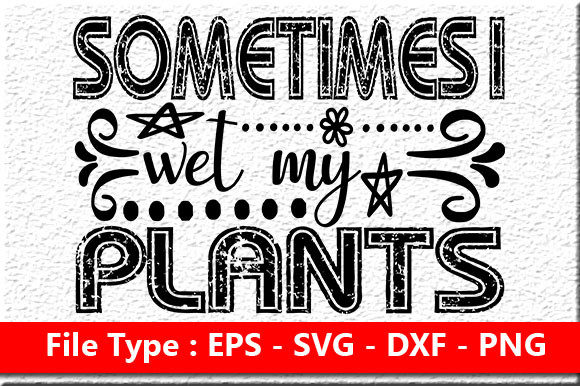
Garden Quote Design, Sometimes I Wet My
Let’s be honest: not every garden quote lands with the same charm—or stitchability. As a designer who’s digitized, tested, and shipped thousands of embroidery files for small shops, Etsy sellers, and custom apparel brands, I opened Garden Quote Design, Sometimes I Wet My expecting whimsy—and found something more useful: quiet confidence. It’s not loud or overly cutesy. It’s grounded, gently humorous, and visually balanced—exactly what you want when embroidering a linen tea towel for your boutique or stitching a baby onesie for a client who gardens barefoot.
A Design That Breathes With Your Fabric
The first thing that stands out is its rhythm. The phrase “Sometimes I wet my plants” flows in a soft, slightly curved line—not rigid, not cramped. There’s breathing room between letters, and the lowercase “i” dots and “t” crossbars are generous enough to avoid disappearing under satin stitch. No tight serifs or fragile ligatures. That means fewer thread breaks on cotton twill, less risk of skipped stitches on lightweight rayon blends, and cleaner results on textured fabrics like canvas tote bags or woven kitchen towels.
I tested it on a medium-weight organic cotton sweatshirt—a common request for small-batch apparel makers. With light tear-away stabilizer and 40-weight polyester thread, the design stitched cleanly at roughly 3.5" wide. The letterforms held shape without overfilling; no dense fill-stitch patches drowned out the garden theme. It didn’t scream “embroidery”—it looked handmade, intentional, and quietly clever.
Where It Shines (and Where to Pause)
Garden Quote Design, Sometimes I Wet My works beautifully for:
- Personalized gifts: Embroidered on a linen pillow cover or ceramic mug sleeve, it reads as warm and human—not generic clip art.
- Boutique merchandise: Think aprons for plant shops, tea towels for local nurseries, or baby bibs for eco-conscious parents. Its tone fits curated, values-driven branding.
- Etsy listings and craft fairs: Customers respond to sincerity. This isn’t forced punning—it’s relatable, gentle humor that photographs well in natural light.
- Digital product previews: The included SVG and PNG files scale cleanly for printable mockups, social media banners, or listing thumbnails—no pixelation, no jagged edges.
But here’s where attention matters:
- Small hoop sizes: At full width, it may push the limits of a 4x4 hoop—especially with stabilizer margin. Trim excess fabric before hooping, or consider slight scaling if your machine struggles near the edge.
- Stretchy or thin fabrics: On knits or lightweight voile, use cut-away + topping (like Sulky Solvy) to prevent puckering and keep letter clarity.
- Dark or textured backgrounds: Test thread contrast early. A soft sage or terracotta thread reads better than stark white on charcoal linen. Avoid metallics—they’ll obscure the subtlety.
- Curved surfaces: Caps and curved tote handles demand re-hooping or repositioning. The clean baseline helps, but don’t expect perfect continuity across seams without manual adjustment.
What It Does for Your Craft Business
This isn’t just another graphics file—it’s a subtle brand amplifier. When customers see Garden Quote Design, Sometimes I Wet My on a hand-stitched patch or embroidered sweatshirt, they’re not just buying decor. They’re connecting with a voice: calm, earthy, lightly self-aware. That builds trust—especially for Etsy sellers positioning themselves as mindful, small-batch creators.
For commercial embroidery projects, it holds up under scrutiny. No tiny flourishes that vanish after three washes. No high-density satin borders begging for fraying. The stitch density feels considered—not sparse, not overwhelming. That translates to lower rework rates, happier clients, and repeat orders.
And for digital product sellers? The multi-format ZIP (EPS, SVG, PNG, DXF) gives flexibility without compromise. You can drop the SVG into Cricut Design Space for vinyl decals, use the EPS for vector-based print layouts, or pull the PNG into Canva for quick social posts—all while keeping the original embroidery file intact for stitch-out.
Practical Designer Notes Before You Stitch
Before committing to a client project or bulk production, do these five things:
- Test on scrap fabric that matches your final substrate—same weight, same weave, same stretch.
- Check thread color contrast in both daylight and indoor lighting. What reads clearly on screen may blur on fabric.
- Review stitch density in your embroidery software. If fill areas look heavy, reduce density by 5–8%—especially for baby items or towels meant for frequent washing.
- Confirm hoop size compatibility and adjust placement if needed. Don’t assume centering = automatic fit.
- Verify licensing before selling finished items or bundling the design as part of a digital product. Since this is listed under Crafts and Graphics, confirm whether commercial use is explicitly permitted.
Also: try it in black-and-white mockups. Does the phrase still carry warmth without color? Yes—with Garden Quote Design, Sometimes I Wet My, it does. That’s rare. Most garden quotes rely on floral graphics or pastel palettes to soften their tone. This one relies on spacing, proportion, and restraint.
A Final Thought for Makers
If you’ve ever hesitated before adding a quote-based design to your collection—wondering whether it’ll feel tired, trendy, or too literal—this one earns its place. It doesn’t chase virality. It serves purpose: to delight a fellow gardener, comfort a new parent, or add quiet personality to everyday objects. That makes it more than a machine embroidery design. It’s a small, stitchable moment of shared understanding.
Use it thoughtfully. Test it thoroughly. Let it breathe on the fabric—not rush across it. And when your customer smiles at “Sometimes I wet my plants” stitched onto their favorite tote? That’s the detail that turns a handmade product into a keepsake.